 Home
Maison
Collection
The Movement
Retailers
Heritage
Enquire
Request an Appointment
Home
Maison
Collection
The Movement
Retailers
Heritage
Enquire
Request an Appointment
The Lineage
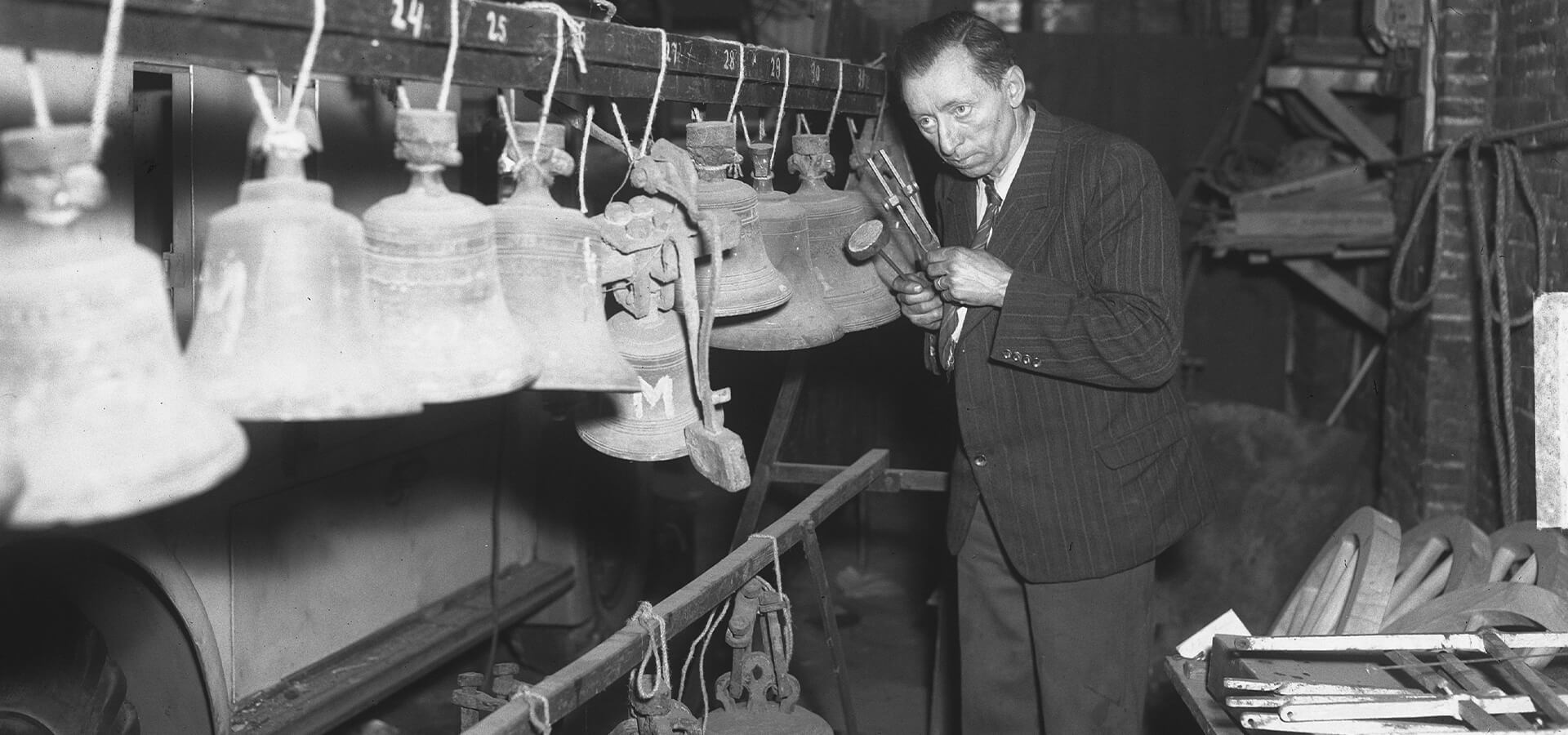
What follows is not a brand story written backwards. It is a documented lineage of six generations who cast time into bronze, and a seventh who carries it to the wrist.
The Timeline
Andries Heeres I establishes the family's first workshop in Midwolda, Netherlands. When the town's church bell cracks, he boldly offers to recast it, having studied the techniques of German masters Claude and Mammeus Fremy. His successful casting of both a 240 kg and a 2,000 kg bell immediately generates new orders from across the region. A dynasty is born of bronze and precision.
At the age of 78, Andries Heeres I achieves an extraordinary final act: casting 148 bells in his last year. The modest Midwolda workshop had by now produced hundreds of bells throughout Reformed churches across the Netherlands and Germany, making Van Bergen synonymous with Dutch bell founding.
Andries Heero II establishes the Sint Paulinus foundry in Heiligerlee, a modern industrial operation with a large casting pit. Its reputation grows rapidly through World Fair exhibitions in Vienna, London, Philadelphia, Paris, Amsterdam and Antwerp, where Van Bergen bells win gold and silver medals.
Brothers Andries Heero III and Udo Jurrien van Bergen take over the company. In 1904 the brothers separate their holdings; Andries Heero III continues the bell foundry, bringing a new era of technical sophistication. His portrait endures as the face of the dynasty's golden age.
Van Bergen receives one of the Netherlands' most prestigious honours: casting two bass carillon bells for Utrecht's Dom Tower to complement the legendary 17th-century Hemony carillon. The commission catalyses years of research perfecting carillon tuning.
Van Bergen completes the first Dutch tuned carillon in 200 years. H.R.H. Princess Juliana attends the historic dedication ceremony at the Utrecht Fair. By 1937, no English founder supplies carillons to the Netherlands.
The iconic carillon tower at the Heiligerlee foundry is completed, becoming a landmark of Dutch bell founding. A 38-bell demonstration carillon follows in 1946, attracting delegations and orders from across the world.
H.M. Queen Juliana visits the Van Bergen factory in Heiligerlee. Two years later she presents Van Bergen bells as a state gift to President Truman. They ring today at Arlington National Cemetery.
Van Bergen recasts 58 bells for Riverside Church in New York, then the world's largest carillon, a memorial commissioned by John D. Rockefeller Jr. Andries Heero IV had detected tonal imperfections in the existing bells and dared to say so. No other founder had been willing to name the flaw. That trust, earned by unflinching honesty, endures in the Van Bergen 1795 DNA.
Van Bergen casts its last bell on 11 April, for Sleen's Reformed Church. Under Dipl. Ing. Andries Heero van Bergen V, the foundry closes after 185 years of uninterrupted production. Not an ending: the accumulated knowledge of six generations is preserved, waiting for the craft that would carry it forward.
Baron Juchter van Bergen Quast, grandson of the final bellfounder, and Erik Meijer begin exploring how two centuries of acoustic engineering mastery could be translated into haute horlogerie. Both disciplines demand absolute mastery of metallurgy and precision, and both aspire to mark time with a voice.
Bhimrapa Meijer joins as Chief Strategy Officer. The team begins development of what will become the largest hammer ever set into a wristwatch. The entire timekeeping calibre is conceived within the spatial boundaries imposed by the striking architecture, ultimately achieved at 2.5 mm. Every component is refined by hand.
A co-development agreement is signed with one of Switzerland's most distinguished independent movement ateliers. Prototype production begins. The world première at Top Marques Monaco is confirmed under the High Patronage of H.S.H. Prince Albert II of Monaco.
Van Bergen 1795 débuts at Top Marques Monaco. The Heero Collection carries 230 years of acoustic legacy to the wrist. What began in the bell foundries of Midwolda in 1795 finds its most intimate expression yet: the largest hammer ever set into a wristwatch, striking the half-hour in a voice worthy of the dynasty that cast it. The bells speak again.
The accumulated knowledge of six generations was never lost. It was kept, waiting for the craft that would carry it forward.
Van Bergen 1795
The Seventh Generation
It waited. The Heero Collection is the moment the dynasty speaks again, in a register small enough to wear.